 Family Buddy
Chore rewards, agreed before anyone asks
You decide what it takes to earn a zoo trip. Your child earns points for finished tasks, and for the things that were never on the list, and the total climbs toward it. Because it was agreed before anyone asked, there’s nothing to settle at the moment it matters.
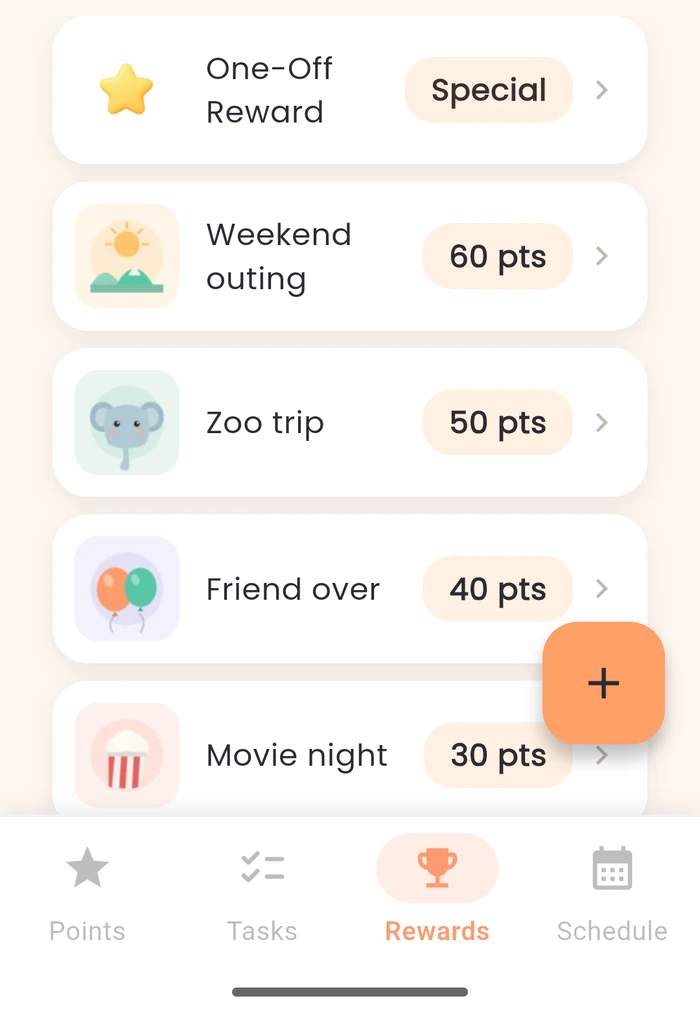
Rewards you choose, and you decide what earns them.
Points for the things that were never on the list
This is the part a checkbox chore app can’t do. There is no box for was kind to her brother, or tried hard at something difficult, or helped without being asked. In Family Buddy you just tap plus. It doesn’t have to be on the list.
Effort and attitude are usually the things you most want to encourage, and they’re exactly the things a fixed task list has no room for.
Why agreeing it first ends the bargaining
The argument is rarely about the reward. It’s about the deal being made on the spot, which means it can always be renegotiated upward. When the rewards list already says a zoo trip is fifty points, the conversation is about how close they are, not about what it should take.
You choose what goes on the list and what each one is worth. A movie night, a friend over, choosing dinner. Plenty of them are free.
Best for
parents tired of bargaining on the spot, where every good deed becomes a fresh negotiation.
Not for
parents looking for a pocket-money app. Rewards here are things you choose: a zoo trip, a movie night, choosing dinner. Earned with points, never money.
Questions about points and rewards
How do points and rewards work?
Parents assign points to tasks. Kids earn points by completing tasks. When the total reaches what you agreed, you redeem it: extra play time, a small treat, or a family activity.
How do I set a reward before my child starts asking for one?
Put the reward on the list first, and set what it takes in points: a trip to the playground, extra story time, a small treat. Then when the question comes, the answer is already agreed and it isn't a negotiation. You decide what goes on the rewards list and what each one takes, and you can change either at any time.
How many points should I give for brushing teeth, tidying up or other tasks?
Easy tasks should be 1 to 2 points and bigger tasks 5 to 10 points. Consistency matters more than perfect math. If kids lose interest, shorten the distance to a reward.
Can I give points for kindness or trying hard, not just completed chores?
Yes. You can award points anytime for good behaviour like helping out, kindness, or trying hard, on top of points earned from daily tasks.
Do I need to reward every chore? Will this turn into a bribe?
No, and it's your call which is which. Some families treat basic responsibilities as simply expected and use points only for extras; others do the opposite. Family Buddy doesn't decide that. You choose what goes on the list and what each thing is worth, and you can change it whenever you like. The only thing the app changes is timing: it’s on the list before the question comes up, rather than being settled in the middle of one.
Do I need to use rewards forever?
No. Points and rewards are training wheels. Once a routine is stable you can reduce rewards and keep the routine. Many families keep rewards for a few key behaviours and drop the rest.


You’ll land on “Family Star”. That’s us. We’ve renamed to Family Buddy, and the App Store listing is still catching up.
New to the whole idea? Start with the chore chart →
Appointments and school trips as well as the routine? See what’s on this week →
Family Buddy has no account and no sign-up. How your family data is handled →